
Updates
Life was never meant to be easy... But it surely wasn't meant to be this hard.

Today is one of the rare days in the last ten weeks where, even though it isn’t anything like crisp and clear, I can sort of see what I might be doing. I apologise in advance for any spelling mistakes. If I missed correcting them, it’s because I am struggling see them properly.

Many of you know that I didn’t get tenure at King’s. Nay, in fact, and after not one, not two, but three rounds of advertising the post and interviews, they eventually replaced me. For my first update I was reliably informed by people who have experienced the new and *cough improved digital technologies for healthcare class that I pioneered and as taught by my replacement, that it is not in any way receiving the massively positive student evaluation scores and feedback that I received. No hard feelings or gloating on my part. I was uniquely placed to develop and teach that class. I was someone who trained in nursing a long time ago but spent almost two decades working on technology, including health technology. While my version received high praise on its first outing a new lecturer, even one who by all accounts may even be an excellent nurse first but who presents with no actual computer science, electrical engineering or solution development training or experience, might not be the best option to present such a cross-domain course.
It is a sad reflection on many non-computing domains that they figure they are, by virtue of having played with spreadsheets and a few apps on her phone, and after chatting with some hallucinating AI in a web browser, experts in digital technology. In truth, and I published a substantive paper on this with Professor Norman Fenton and members of his team reviewing a large number of academic papers on health AI that bear this fact out, too many nurses and doctors think that using Grok and ChatGPT or an app on their iPhone makes them an expert in technology and, similarly, an even larger number of computer scientists with no training in the health domain think that reading a few academic papers on angina, type 1 diabetes mellitus or cancer in order to create a computer model makes them an expert on complicated health conditions. Many professional schools, whether those training doctors, nurses, midwives, lawyers, accountants or some other form of certified professional, recognise that they need to teach some technology to the next generation. However, rather than having someone like myself with training and experience in both their own and the technology domain, they employ people exclusively trained in their own domain who simply profess an overactive (or in some cases hyperactive, as in ADHD or Asperger’s) interest in the tech. Along with DEI and the whole gamut of Marxist nonsense unrelated to the actual qualification being studied that is foisted upon today’s tertiary student, this is another reason why current day university education is a race to the bottom. To stupidity. To the future portrayed in the Idiocracy movie.
Have you ever noticed how university academics often claim a long laundry list of additional expertise, often under the sometimes misleading banner of research interests. Too many university lecturers and professors claim expertise in areas that are anything from at best peripheral to almost not even incidental to their actual training and qualifications. Law professors with an undergraduate qualification in general law subjects and PhD research in civil small claims law that claim expertise in international space law. Nursing lecturers who hold a general/adult nursing Bachelors degree, a Masters in Critical care, experience solely in medical/surgical wards, one critical care unit and elder care, and who wrote a PhD in something like clearance of the breakdown elements of medicines in critical care nursing who claim an expertise in the development of neural networks to diagnose and treat epilepsy and other acute neonatal neurological conditions. Some do this simply because these additional areas that were demonstrably not covered in the modules they studied are areas of personal interest - that because they are interested in the topic and maybe read some the often consensus-repeating and potentially useless “peer reviewed” papers on the topic, they are an expert. Others claim this expertise by virtue of the fact that one of the students they had wrote a research assignment or thesis on the topic - effectively claiming to have acquired the knowledge from their student, perhaps purely by osmosis?
I use these examples because they are similar to ones I saw during my limited academic career. First, an early-to-mid twenties senior lecturer with only an undergraduate degree in Law and a postgraduate certificate in tertiary teaching who admitted no training or experience in software development, computer science or technology who were hired to develop and teach a Masters qualification in AI and Law where the individual was attempting to teach development of legal neural networks by showing a class of undergraduate Law (LLB) graduates lecture videos from another university’s online MOOC course, never mind that he could not program these models himself nor assist the students when they attempted the assessment activities described in the MOOC course. Second, I also saw a nursing lecturer who appeared to have only minimal clinical experience and no training in computer science who presented herself as an expert in health data science and the use of AI who, after claiming this expertise in a lecture before other academics and a large group of students, proceeded to give a demonstration of the use of an AI processing health data. Showing the full screen of her laptop on projector screens over her head, she opened a Chrome browser window, logged into the well-known LLM AI tool’s website, and proceeded to have it process several hundred patient records from a local folder on her laptop. She stated that the records were real but had been anonymised but, when shown on screen, clinicians from that hospital immediately commented that they clearly still included the patient’s unaltered record ID number from the hospital’s computer system, as well as the patient’s home postcode, age and significant diagnosis and medicine dispensing data that would make re-identification of the patient fairly easy1. When asked, she demonstrated her ignorance of how the LLM AI tool she was using worked. She incredibly claimed that because the health records were on her laptop, the browser-based AI processed them using her years-old £600 Dell laptop and was not uploading or consuming them into the website servers the tool operated from. Even when it was shown to her that the icon for her wifi connection was showing hundreds of megabytes of data being sent to, not received from, the network, and that absent installation of a local version of the AI model, the data had to be sent to the AI model’s servers for ingestion. Even when she was shown evidence from the AI tool’s provider website that categorically stated that documents shared with the AI in a browser session were uploaded to their servers for analysis and processing, she still argued she knew more than several qualified and experienced technologists, myself included, who were present in the lecture theatre. This senior lecturer ignorantly gave what she admitted was real, and almost certainly re-identifiable, patient data to a commercial LLM AI product.
You cannot become proficient, let alone expert at something, if you are learning it from a professor who themselves is not an expert in that domain. I was the rare exception in that when I wanted to do research or teach in a domain, be it nursing, medicines and medicine, law, business, information and data science or computer science, I at least successfully studied the core modules or an entire degree and got some runs on the board in that domain first. Why? Because I believe a researcher, lecturer or even professor who either taught themselves a domain outside their qualification by reading the half-baked nonsense in many present-day “peer reviewed” academic papers, or who learned the incomplete things they are teaching from a prior unqualified inexpert making what they are teaching today, much like a photocopy of a photocopy of a photocopy, of even lower academic quality, is categorically not an expert and their teaching is not worth the thousands of dollars in fees each student is expected to pay. At best they are the blind leading the blind.
Which is an unfortunately apt segue into the next update…
It is five days later that I come to write the second update. Over the intervening five days my eyesight has continued to randomly shift between mostly okay to completely blurry with polyopia (double, triple and sometimes even quadruple vision in one eye), and for four out of the five days I had some variation of moderate headache or migraine and upper cervical (neck) pain and nerve spasms in my left shoulder. The problems with the vision in my right eye (my only working eye) have been intermittent for most of the last thirteen weeks - where I have either had mostly clear distance-field vision but blurry near-field vision, mostly clear near-field vision with blurry distance-field vision, or blurry vision in all fields. On some very rare days, perhaps one in every ten, I have had my normal mostly clear and functional vision back. Something I have found interesting, scientifically speaking, is the effect of what I believe our friends in the physics domain might call interference patterns… those times where the misaligned diplopia or triplopia images cross over or cancel each other out. I have observed these turning an X on a number plate about four metres away into first what looks like a capital A, and then after blinking a few times, into a capital V. It is like seeing some version of British polymath Thomas Young’s2 1801 double-slit experiment in my own head. Interesting, but I can tell you, also extremely disconcerting.
If you have never heard of it, this image is an approximation of what diplopia/triplopia looks like. It makes it very hard to read signs, look at text on a screen or in books, or even to simply make yourself a sandwich without potentially cutting yourself. Ask me how I know…
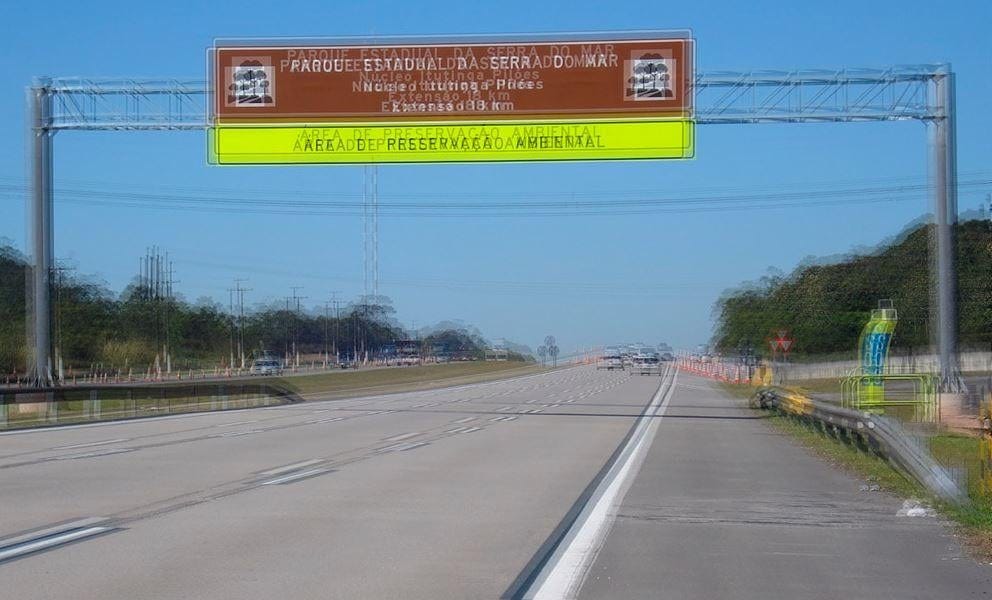
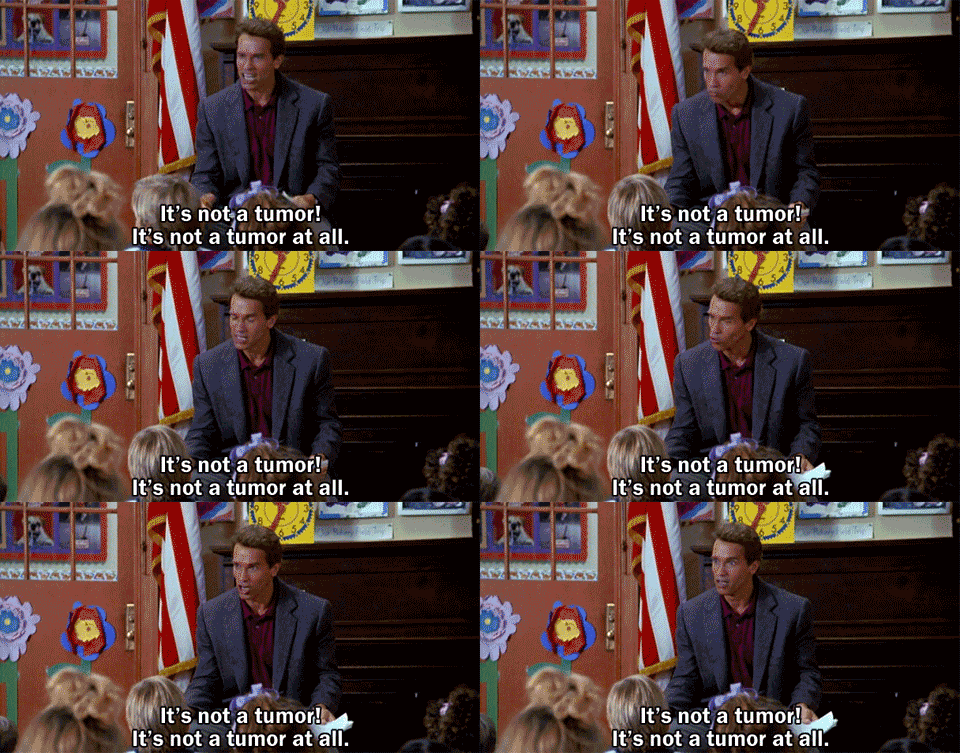
Sadly, a lot of my research has come to a halt. It is very difficult to read academic papers, Letby court transcripts and textbooks when text appears as a long grey snake with occasional lines in it due to the polyopia. While the text size on the huge 57” Samsung G9 monitor I am forced to use has had to be enlarged several times, the headaches and migraines have made it impossible to sit in front of a screen most days. I have seen several doctors and already been subjected to hours of tests. One doctor thinks it is all in my head - oh great, so I am imagining that my vision is so blurry that I walk into walls, fail to see steps and trip, reach to pick up things that turn out to be not where my brain thinks they are, have already accidentally put a steak knife through my left thumb and had to stop driving and flying drones. Another said it was temporary and would get better on it’s own - except that thirteen weeks later it is still here and not getting any better. A third thought there may be a brain tumor - I am hoping (rather, I am pretty sure) that the MRI I am about to have will allow me to channel my inner Arnie.
A fourth thinks it might be neurology’s latest catch-all diagnostic ‘explanation’, benign intracranial hypertension, which enables neurology’s latest panacea, regular lumber puncture draws to reduce the amount of circulating cerebrospinal fluid. A fifth finally considered something I have had for several years, meibomian gland dysfunction (MGD) which causes extreme dry eyes, and at least treated that. However, while treating that made my eyes sting less, it didn’t resolve the polyopia or headaches. The third at this point re-evaluated his tumor diagnosis and referred me to a sixth doctor who was another eye specialist who found ‘a few inflamed cells of posterior uveitis’. This, he treated with prednisone drops which, I must admit, got rid of the feeling that my right eye was going to pop out of my head… but sadly, it did nothing to resolve the polyopia or headaches. And so, at this point and after my wallet has been made considerably lighter, the original issue persists and we have ruled out several potential differential diagnoses.
Given that today I have had a few hours of semi-working vision, I have developed my own admittedly crude differential diagnosis model using Bayesian networks (thanks to Profs Fenton and Neil). That model, using academic literature and a dataset of over 3.2 million anonymised health records, resolves that a brain tumor has only a 4% probability, and a blocked gland causing transient horizontal astigmatism is 9% probable - and given I have a blocked gland in the upper lid is maybe more likely than that. It also strangely found based on some other symptoms I have at the moment that RA or SLE autoimmune disorders affecting my vision and causing headaches is 19% probable. However, the diagnosis that apparently accounts for the largest number of symptoms at 38.94% probable is that compressed, pinched or irritated upper cervical nerves that can also cause referred issues with blurred or double vision and headaches. I managed to identify several published case notes and academic papers supporting this potential diagnosis and, after some considerable back-and-forth, managed to use these to convince the last specialist to extend the MRI brain that has been ordered to also look at the cervical spine and nerves. My wallet will be even lighter as I have to pay for this MRI, but it will at least rule in/out a tumor, referred cervical nerve issues and a number of potential issues with blood flow such as a clot, mini-stroke or blood vessels restricting or impinging on the optic nerve or occipital lobe. Given I have no income and cannot effectively work, or work safely, when I cannot see… spending hundreds of dollars each week to find out or test treatments that aren’t the cause is frustrating.
The third update is that I have to call out the disgraceful lack of support I receive from the country of my birth. A country that is more willing to support and provide discounted homes to the more than one million Indian immigrants. A country that has spent millions to bring ISIS terrorist brides and their children who have almost certainly been inculcated to hate our western values here and provide them with housing and income support benefits. A country that spends hundreds of millions on failed green energy and electric car and truck projects while stealing arable land from our farmers and driving up the price of everything. A country where the Prime Minister’s obscene $7+ million dollar annual expense claims, a rate double that of his predecessor and more than four times that of any prior Prime Minister, is totally overlooked and treated as normal. A country that has brought in over 60,000 Pakistani muslims in the last couple of years under the ‘skilled migrant’ visa class, of which at least 13% are currently said to be receiving unemployment, carer or some other form of social welfare benefits - a benefit recipient rate that is 300% more than the 4% of white Australians in the same position.
In that same country I was interrogated, investigated and made to wait two months before finally receiving any form of benefit at all. I received a part-payment of that benefit for less than a month (April) before… you guessed it… even that was taken away from me and I was subject to the claim that in giving me those few weeks of part-payments, I had been ‘overpaid’. They got here through gross manipulation and deception. First, they sent a single letter saying I needed to call within fourteen days of the date on the letter or payments would be stopped. The date on the letter and the date on the envelope’s postmark were eleven days apart, but you never get an explanation as to why this might be the case. In any event, I called three times on the day I received the letter. Each call was met with a recorded message telling me their phone service was busy, that operators were not available to take my call, and thanking me for my call before terminating the call. My mobile phone bill shows each of these calls. So I called at 8:30am the following morning and was told I had been put ‘in the queue’, and that my approximate hold time would be forty-five minutes. Three-and-a-half hours later I was finally answered by a chap who told me he was located two time zones away from me. He followed this by telling me he was somehow unable to ask me the simple questions that the letter writer intended… even though he actually did ask and he recorded my responses in notes attached to my file. He concluded by saying someone else would have to call me, and he allocated a specific time when he said this would occur. But here is where the games begin…
The person who was allocated to call called on the right day, but at a time earlier than the allocated time. In what was clearly a non-native accent she failed to appropriately identify herself before launching into asking me for a lot of my own personal details. When I challenged this, she stated that in telling me her first name, she had ‘identified herself’ and that any doubt should be allayed by the fact that I should have received a text (SMS) message telling me to expect her call. Truth be known, the text message arrived to my mobile at 11:04am, almost two-and-a-half hours after this call ended. It should not be forgotten that when you send a text message may not be the same as when that text message is received. This results from a myriad of telephony provider inter-network or handoff and intra-network issues, and simply whether your mobile has ‘service’ at the time. Leaving this aside, the government’s own intelligence and cyber-security websites currently tell citizens on their landing page that hackers and fraudsters are faking text messages from important financially-related services like the tax and benefits departments, and not to trust, respond, follow links or act on such messages. Which is it? Are we supposed to believe these messages, even when they come late, represent the government department or public service and hence give our personal details to the person who calls and says they sent that message, or are we to consider them entirely suspect and not respond? In any event, it is hard to know when the person calls at a time other than the one that has been recorded, and the text message comes more than two hours late. When I informed the caller that her call was at the wrong time, that I had not received the text message she claimed had been triggered that morning, and that unless she could provide me with some proof that identified she was from the department she claimed to be from, I did not feel comfortable providing her with a continuous stream of personally identifiable information beyond that which I had already provided. She became argumentative and abusive, and when her abuse only received the same considered and calm response from me, she said something that sounded insulting and terminated the call. Unbeknown to me, she had been from the benefits agency and after ending the call, put some fairly unkind notes into my digital record. She also scheduled a new telephone appointment but, and here’s the kicker, disabled the requirement for me to be sent a letter or notification of that new appointment time. This meant I was not advised in writing, either by email or post. However, on this second occasion, two days later, I received a text message at 9:34 am that said someone would call from a Private Number at 10:15am. Nobody called at 10:15am, nor any time after that. Rather, my phone received a call at 9:48 am, almost half-an-hour early and while I was in the bathroom. My phone shows that unanswered call rang for all of seven (7) seconds, not even completing the second ‘ring’ before it was terminated by the caller. A second call followed at 9:52 am that rang for four (4) seconds before the caller hung up. I only found these calls when I came to pick up my phone just after 10:00am to pair the phone to my bluetooth headset. When I found out the following monday that my benefits claim had been reversed, and I called to ask why, I was told that because I had not answered these calls that came almost half-an-hour before their allocated appointment time and which were terminated before most normal people could have answered them, I was at fault and I was no longer entitled to support. Never mind that they acknowledge there are no suitable jobs for me where I am now forced to live. Never mind that I have a dependent child. And never mind that I am currently being treated for a medical condition that means I am without clear sight in my only working eye and even if there was a suitable job, I would be unfit for and therefor unable to undertake it.
To add insult to injury, even after reversing my benefits ‘claim’, they are still sending me letters demanding that I immunise my thirteen year old son to the degree that pharma money conflicted politicians have decided, else I will lose more. Fun fact, and leaving aside that coercion is not consent, when you have taken everything away Mr or Ms public servant, there is nothing else to take. Even if I was inclined to poison my child with the up to sixty toxic injections they are insisting he receive within 12 weeks, there is no incentive to do so when they have already taken all financial support away. Their threatening and coercive letter is at best vapid hot air, and at worst the work of mentally deficient public servants seeking to rub salt into the wound. If they want to spend what would undoubtedly be over $8,000 in public funds and doctor’s fees to give him all these jabs, why not give me that money as the benefit you are supposed to be giving me to feed and house him? What a retarded world we now live in that it is more important to pay money to doctors and pharma bros to turn our children into patients for life than to help their parents to feed, clothe and house them. In any event, this third update is exemplar for why I have spent most of my life working and living overseas. Through my adult life I have yet to receive anything approaching support, or even a job, from the country of my birth. Instead I continue to watch as my country, and likely yours too, spends our tax dollars to support people from other countries… people who are orders of magnitude more populous than us but who disingenuously claim minority status in our previously sane but now Marxist DEI overrun western countries.
I finish this post not knowing what my vision and visual acuity will be like when I awake tomorrow. I can already see the telltale signs of diplopia, double vision, returning, which doesn’t bode well. I have to wait another six days for that expensive MRI, and even then I am not assured of answers. The country town I grew up in has gone from having some of the best GPs and two of the country’s most respected eye surgeons3 when I was young, to being a dumping ground today for doctors, many of which were trained in places like India and central Africa or are simply those who didn’t make the cut to get into a specialty in what we call the big smoke. Too few chose to be here… and I suspect it might be only the ones who actively chose to be here that make up for the rest. While a couple of the ones I have had to meet in the last thirteen weeks have been really good, I admit to being worried for the patients of the rest. After all, every single one has had an opinion on what they think my diagnosis is…
But three months in, I still don’t have a cure.
*** *** *** ***
Don’t forget that my book about the corruption between academics and big pharma is available via a donation and digital distribution model. Anyone who would like a digital copy can donate GBP £12, AUD $23, CAD $22, USD $17 via my Buy-Me-A-Coffee page. Forward the receipt or drop me an email to redscott@techie.com so that I can match it up at my end and I will reply with a copy of the digital PDF file.
If you are a publisher who is willing to print my book, message me.

*** *** ***
Law, Health and Tech is a user funded publication. You can support this publication and my ongoing work either through a paid subscription here on Substack, or by making a donation on my Buy Me A Coffee page.
*** *** ***
For reference, I did significant research not once (described in my MPhil) but twice (during my postdoctoral work)into anonymisation and re-identification of anonymised patient records. In most cases between 17-80% of so-called anonymised medical records have been found to be re-identifiable… with the larger end of the spectrum being in records, like hers, that still contained useable patient identifiers.
I consider myself a much less capable form of polymath, and have always looked upon Thomas Young with considerable respect. For those who are interested, Ancient Egyptian hieroglyphs would never have been translated by Jean-Francois Champollion if it wasn’t for Young’s breakthroughs in identifying names (specifically the Ptolemy cartouche) on the Rosetta Stone. Also, and perhaps more relevant to my own optical issues, Young was first to describe how: (1) the eye focuses by changing the curvature of the crystalline lens; (2) how we see colour; and (3) astigmatism.
Including the amazing but sadly, recently deceased, William Joseph Barnett (see here and here). I believe I was Bill’s first paediatric surgical patient when he came to town and joined the established practice of Dr Baker. Bill spent most of the evening and night of Good Friday 1984 using all the skill he possessed to try and save my left eye from certain destruction. The nurses commented that it was one of the first times they had ever seen a consultant surgeon stay on the ward at night so as to be available should his patient have any post-surgical issues. And I have never forgotten that when his own children heard about the child whose sight he tried to save, they told him to take one of their large chocolate Easter gifts and give it to me. Somewhere in my desk drawers here, I still have the message that was written to me on the red tissue paper wrapping. Through no fault of his, and due entirely to the severe and significant damage my eye sustained, I lost the fight and almost a year later, lost the eye. But there are few doctors coming out of medical schools today who care as much about their patients as Bill did. Fewer still today who will inconvenience their golf game, property investments, fine dining or a single night of family time for a random patient. As you can see from my current situation, doctors today could learn a lot from the example Bill Barnett set, showing that medicine is a calling to heal and restore, rather than a mere ticket to those big pharma and health insurance dollars.
Update, Scott...Your adversities are much more than anyone should be forced to endure...Your work while employed alongside Professors Fenton and Neil is a valuable asset...Thank you for what you did, and continue to do...
The Lucy Letby case, and its aftermath, has exposed such incompetence as to be dangerous...no wonder the most culpable needed to find a scapegoat...