
The Academic Censorship Continues
Even after sacking and bankrupting me, my work is still under attack

After the issues with not getting tenure and losing my job at King’s that very quickly devolved into financial ruin, destitution, and emigration, today feels really bittersweet. This morning, February 13, 2026, I was supposed to be bringing you some big, exciting news...
Except I am not.
You see, today I was meant to be celebrating the release of my new book. This is a book about the academic corruption that has misdirected opioid research and medicines policy in Australia and New Zealand over the last two decades, and how patients in pain have and continue to suffer while a small group of academics get their fifteen minutes of fame and lots of money. A book that faithfully reports on over a year of research and analysis of hundreds of academic papers, academic blog posts and public announcements, media reports and even regulatory panel meeting minutes released under freedom of information.
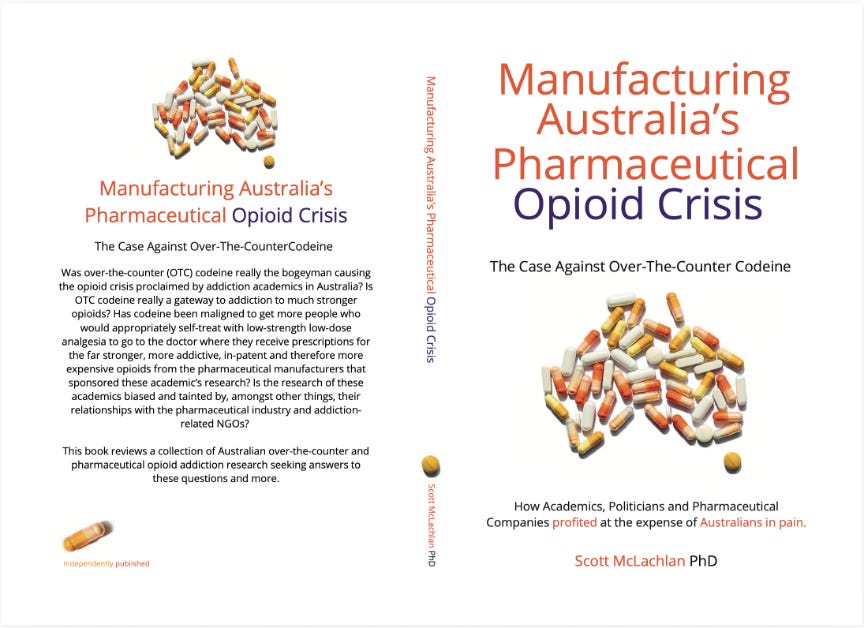
I was supposed to be directing you to the Amazon website where it was to be offered for sale. Except that, yet again, I have been censored. This is a book whose content they have not and cannot refute, so they threatened me. And when that didn’t stop me, they shut down my means of publication to ensure you can’t see it.
Let me backtrack a little here to give you some idea of what has happened along the path that has led to today.
During 2023-2024 I undertook independent research over and above that which I performed on maternal health Bayesian AI models and digital health technologies as part of my role at King’s College London. I worked nights and weekends at home investigating the academic research and academic’s roles in the upscheduling to prescription-only of what, until 2018, had been largely appropriate and safely used over-the-counter low-strength low-dose codeine preparations in Australia. In its first version, this research resulted in a 120-page research monograph.
When I finally showed a few of my closest and most respected research colleagues, I was encouraged by them to identify a small number of distinct issues or themes raised within the text, and to publish these as short, focused papers in the academic peer-reviewed journals. I worked earnestly for over a month before presenting three such papers.
The First Paper
The first paper was an analysis of the knowledge transfer and critical relationships between the tripartite of academia, industry and government, applying the Triple Helix Model (THM). This paper emphasises how the THM fails to consider the potential for ethical and other negative aspects to inhabit and misdirect the outcomes of the tripartite relationship.
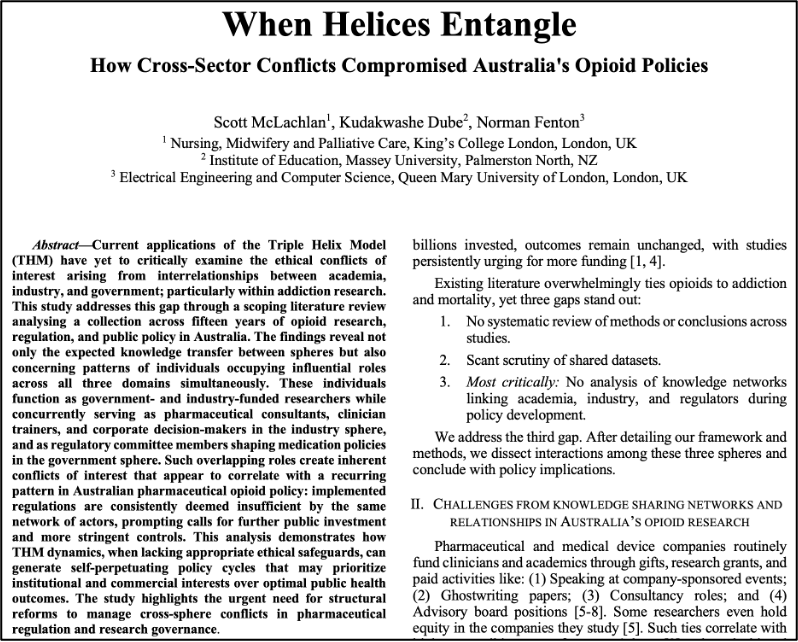
As a test of the honesty and openness to competing ideas in the addiction science domain, the paper was initially submitted in January 2025 to an academic journal, the Wiley Drug and Alcohol Review. I knew that several of the addiction academics whose work is critically appraised within the paper (and my book) are editors on the journal (Suzanne Neilsen, Amy Peacock and Tina Lam, just to name a few), and while I expected push back, the Managing Editor rejected it out of hand without even referring it for peer review. However, what was even more telling and quite disturbing was that the Managing Editor replied with an incautiously worded threat of a defamation lawsuit should the work be published.
What the Managing Editor of Drug and Alcohol Review failed to disclose in that email was that he had been a collaborator and had published with several of the academics whose work I reviewed. For those who will eventually read my book, you will learn that failure to disclose sometimes quite serious conflicts of interest is a common theme in all addiction science research.
If you were to google the title of this first paper, you will eventually find a link to the 2025 Triple Helix Conference that was held in Monterey, Mexico. This paper was eventually peer reviewed and accepted for publication, and was presented by me at that conference. However, while the papers from that conference have been made available in conference proceedings published by the IEEE, the last correspondence I have advises that a “complaint” was made regarding my paper and that it will very likely not be released. We could guess where that complaint came from, but I am sure that would be pure speculation.
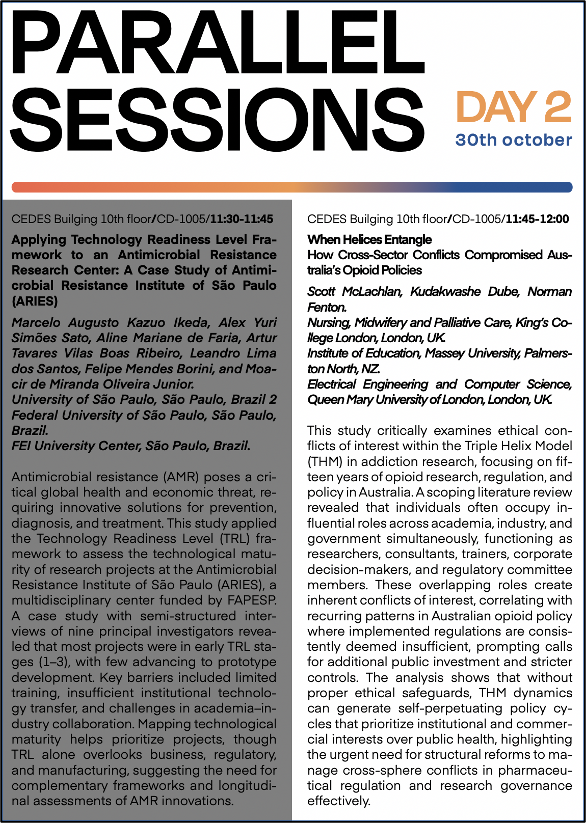
A preprint of this paper released on ResearchGate has been downloaded 144 times during the last few months.
The Second Paper
The second paper proposed an analysis method for and critically appraises the five most frequently used addiction datasets from the collection of papers authored by the reviewed academic researchers. It finds serious issues with every dataset that would lead to under- and over-estimation of what are often surrogate outcomes. These unreliable results are used to create the irresponsibly inflated claim of an opioid crisis related to pharmaceutical opioids, and especially over-the-counter codeine preparations, in Australia.
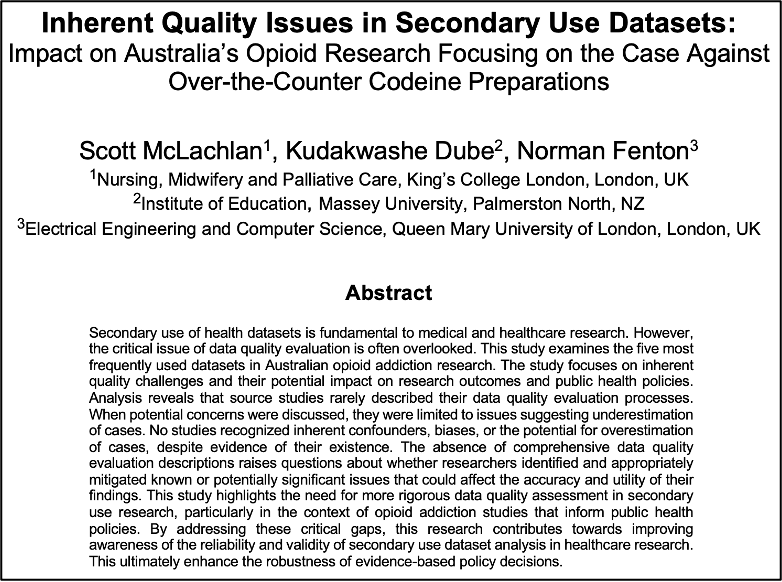
This paper was submitted to and swiftly rejected by the Journal of Health Informatics Research. Their response? They couldn’t find suitable people to review the work. It was eventually resubmitted to the online academic journal PLoS One Digital. PLoS One have already run it through two separate cycles of peer review with three reviewers in each. While the paper was significantly updated after the first round, several of the points raised in the second round are so contradictory to those identified in the first that it would necessitate both completely changing the entire research paper and methodology, but also reversing changes made arising out of the first round reviews. This approach is one often employed by editors and sub-editors of academic journals who really don’t want to publish a work, but who also don’t want to be so obvious as to just reject the work out of hand.
A preprint of this paper has been released today on ResearchGate for my readers.
The Third Paper
While the third paper had several working titles, my favourite and the title it was eventually submitted under was one that came from one of my research collaborators. This paper brings together several of the more important issues identified from my review of Australian addiction research, including significant conflicts of interest, demonstrable biases that saw negative results regarding the research funder’s opioid product removed from the main paper to the often unread supplementary materials, and methodological weaknesses that led to unreliable results and exaggerated conclusions.
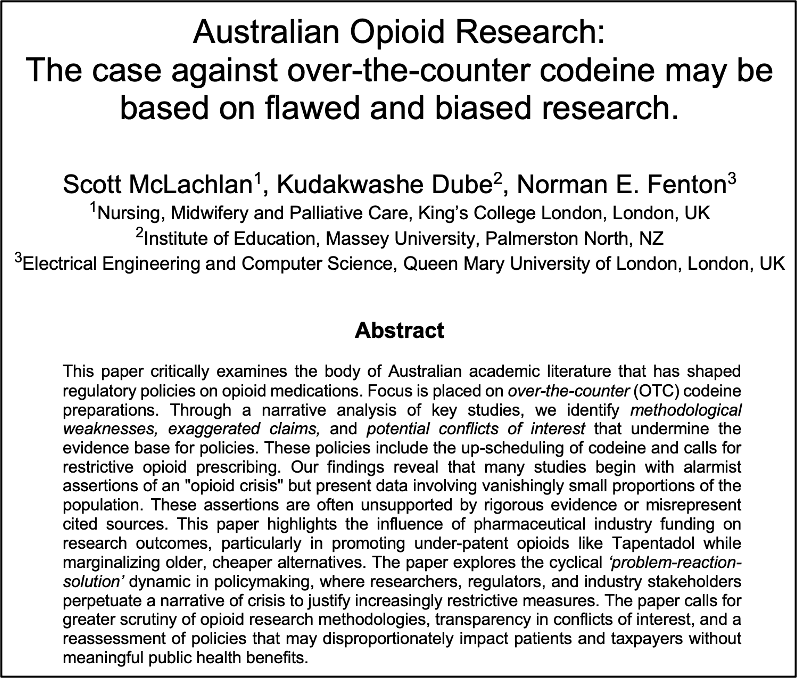
This is the paper I have previously discussed both here on Substack and on X, because the British Medical Journal (BMJ) summarily desk rejected it in only seventeen (17) minutes from submission.
A preprint on ResearchGate has been downloaded 172 times in recent months.
The Book
After having no success getting the academic papers published I returned to the monograph in November 2025, seeking to turn it into a book that I could self-publish. With the encouragement of a great group of collaborators and friends, I focused on developing the manuscript during December and into early January 2026. I created a new Kindle Direct Publishing (KDP) account and invested time in setting out the manuscript in the Kindle template. The amazing Clare Craig gifted me the time of the graphic designer she used for her recent book, Spiked, who improved upon my ideas for the cover and laid the resulting images out in Adobe Illustrator. I uploaded the manuscript and cover in both hardback and paperback forms, pushed go, and the rest was supposed to be history.
Except it wasn’t.
The first email from Amazon’s KDP reviewers came several days later, and stated that they were blocking the paperback version of the book because there were “template elements showing through in the cover image”.
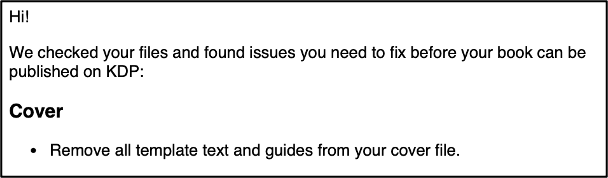
The graphic designer and I reviewed the image file and on finding that there were absolutely no template elements showing in the final cover image, exported a new pair of clean files from Illustrator anyway and uploaded it again. Both passed digital validation and the paperback book again showed as ‘in review’. I requested and paid for proof copies, which arrived several days later.
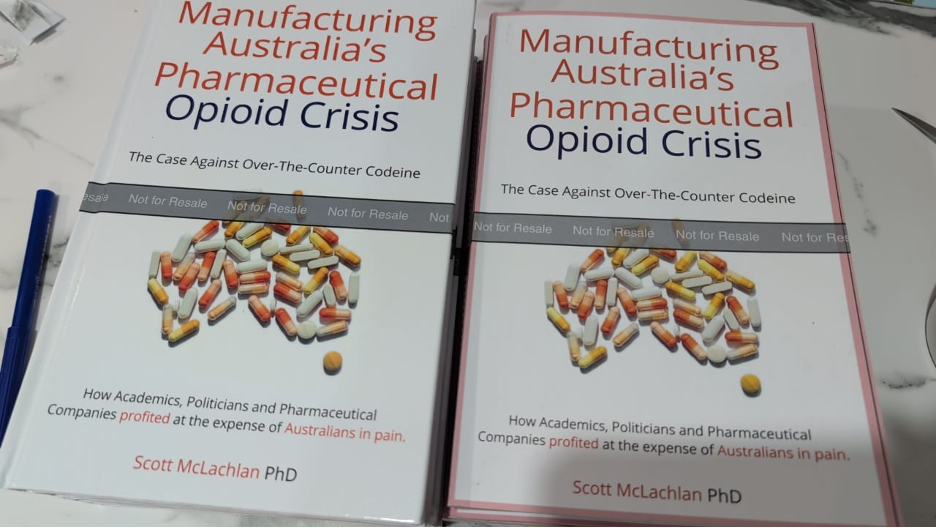
The more detail oriented amongst you will notice that the paperback version on the right has a red border around it. This red border appears to be the so-called template element that we were told was showing in the cover art, yet this red border was nowhere to be seen in the cover art we had uploaded to KDP, and in the second version we exported and uploaded we had copied the graphic elements into a virgin Illustrator file to be sure, so no ‘template elements’ could possibly have existed in that image.
Two days after the proofs arrived, the hardback book passed its review and I was able to order author copies. I ordered twelve hardcover author copies at a total cost of over £170, none of which have ever arrived. By the way Amazon... a refund has also never been issued to my bank account. Perhaps you can get onto that?
The next email I received advised that Amazon KDP would not be accepting my book because it “might result in a disappointing customer experience”.
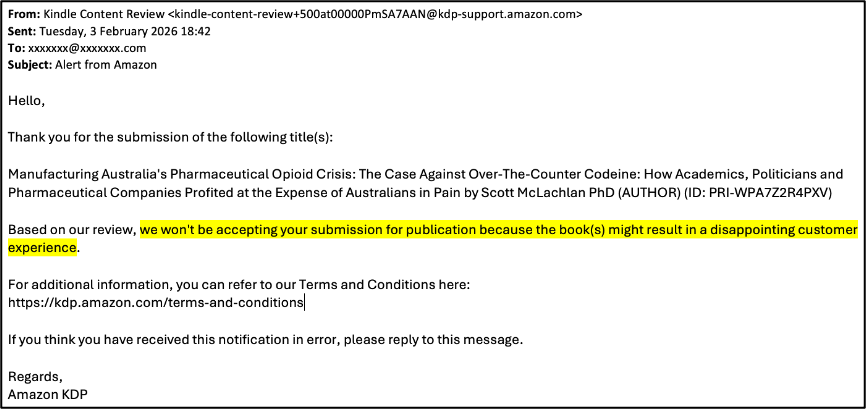
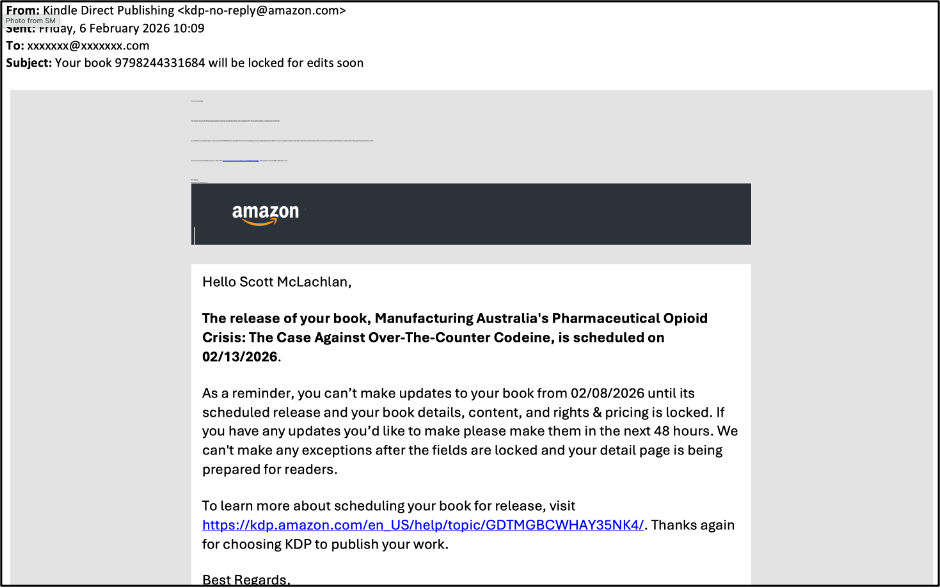
Three days later I received the following email that confusingly suggested my book, which they had already blocked from release, was actually still going to be released.
That same day, after I dared to ask why my book was being blocked, I received the following cryptic response:
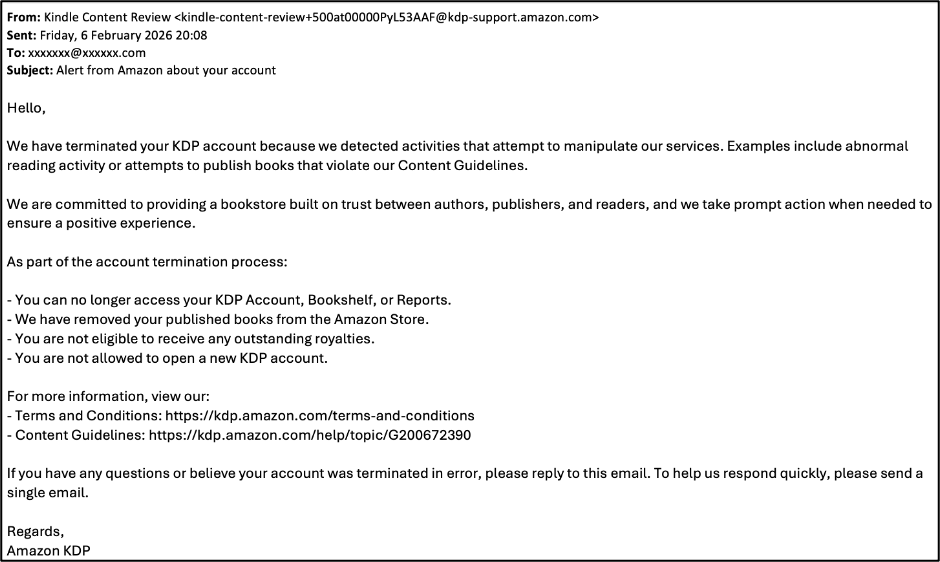
Given that I have never read anything on KDP, and I have never owned a Kindle device that would allow me to read anything on KDP, the only conclusion to be drawn is that some pimply faced youth in Amazon’s review team had decided that my factual research book violated their content guidelines.
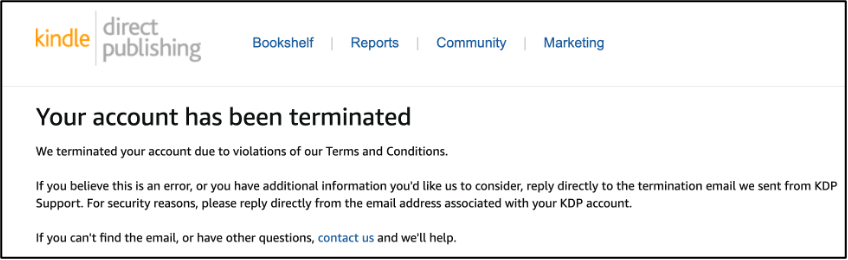
Amazon have not responded to requests seeking clarification of what content violated their rules, as it would seem on review of their content guidelines that no rule has been violated. This means the retraction of my book and closure of my KDP account can only be censorship. My guess? That the same person (or people) at the journal who summarily rejected the first paper and who were very likely responsible for the complaint that has seen the second paper presented at conference withdrawn from the conference proceedings, have approached Amazon and made false claims about the content of the book.
Where to now
At the moment things are in limbo. There is suggestion that the book might be picked up by another publisher who has been instrumental in publishing Covid and post-Covid era censored and dissident works, however things have gone quiet on that front at the moment.
The best I can do right now is to offer this work to my subscribers and anyone else who wants a copy via a donation and digital distribution approach. Anyone who would like a digital copy can donate GBP £12, AUD $23, CAD $22, USD $17 via my Buy-Me-A-Coffee page. Forward the receipt or drop me an email to redscott@techie.com so that I can match it up at my end and I will reply with a copy of the digital PDF file.
*** *** ***
Law, Health and Tech is a user funded publication. You can support this publication and my ongoing work either through a paid subscription here on Substack, or by making a donation on my Buy Me A Coffee page.